

15 Financial KPIs Every UK Business Owner Should Monitor Every Month

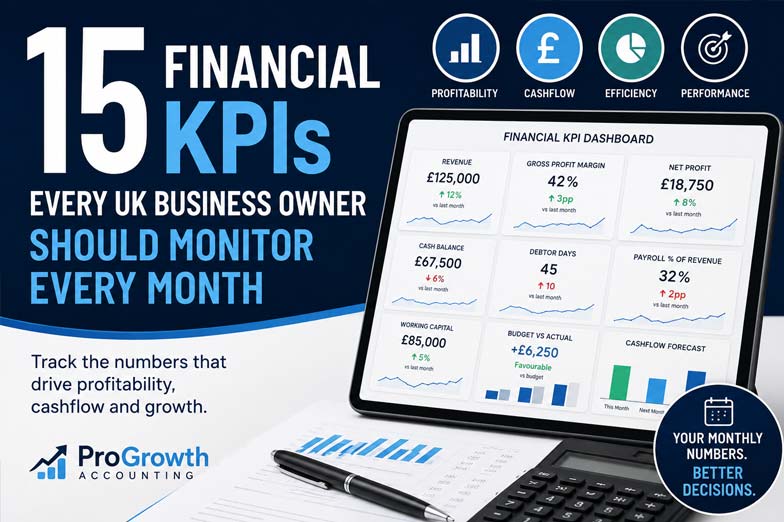
15 Financial KPIs Every UK Business Owner Should Monitor Every Month
If I asked you whether your business had a good month, what would you look at first?
Your bank balance?
Turnover?
How busy your team was?
None of these, on their own, tells you whether your business is financially healthy.
A company can have record sales and declining profits. It can show a healthy accounting profit while struggling to pay its bills. It can have £100,000 in the bank while owing a significant proportion of it to HMRC, suppliers and employees.
That’s why successful businesses use financial KPIs – Key Performance Indicators – to measure what is actually happening.
You don’t need 100 different metrics.
For most UK SMEs, a relatively small number of carefully selected financial KPIs can provide an excellent early-warning system for profitability, cashflow and overall business performance.
Here are 15 that every business owner should understand.
What Are Financial KPIs?
Financial KPIs are measurable indicators used to assess the financial performance and health of a business.
They help answer questions such as:
- Are we becoming more profitable?
- Are our costs under control?
- Are customers paying us quickly enough?
- Can we comfortably meet our liabilities?
- Are employees generating enough revenue?
- Is growth actually creating value?
- Do we have enough cash to fund our plans?
The important point is that KPIs shouldn’t simply be recorded.
They should lead to decisions.
If a KPI changes significantly, the next question should always be:
Why?
1. Revenue
Revenue, or turnover, is the total income generated from your business activities before expenses are deducted.
It’s one of the most obvious KPIs, but it needs context.
Compare:
- This month vs last month
- This month vs the same month last year
- Actual revenue vs budget
- Year-to-date revenue vs target
If turnover increased by 20%, that’s useful information.
But it doesn’t necessarily mean the business improved.
Which brings us to the next KPI.
2. Gross Profit
Gross profit measures what remains after deducting the direct costs associated with delivering your products or services.
For example:
Revenue: £100,000
Direct costs: £60,000
Gross profit: £40,000
Monitoring gross profit helps you understand whether the core activity of your business is generating sufficient money to cover overheads and ultimately produce profit.
3. Gross Profit Margin
For many businesses, this is more useful than simply looking at gross profit.
The formula is:
Gross Profit ÷ Revenue × 100
Using the example above:
£40,000 ÷ £100,000 × 100 = 40% gross margin
Now imagine revenue increases from £100,000 to £120,000.
That sounds excellent.
But if gross margin falls from 40% to 30%, gross profit becomes only £36,000.
You’ve sold £20,000 more but generated £4,000 less gross profit.
This is why turnover should never be viewed in isolation.
4. Net Profit
Net profit tells you what’s left after the business’s operating expenses have been deducted.
Increasing turnover is relatively easy if you’re prepared to spend enough money generating it.
Generating sustainable profit is much harder.
That’s why directors should monitor both revenue and profitability.
5. Net Profit Margin
Net profit margin shows how much profit the business generates from its revenue.
For example:
A business with:
£1,000,000 turnover
and
£50,000 net profit
has a 5% net profit margin.
Another company generates:
£600,000 turnover
and
£90,000 net profit
Its margin is 15%.
Which would you rather own?
The smaller business generates considerably more profit from every pound of revenue.
6. EBITDA
EBITDA stands for:
Earnings Before Interest, Tax, Depreciation and Amortisation.
It is commonly used to assess underlying operating performance and is particularly relevant when analysing or valuing businesses.
If you’re considering selling your company, acquiring another business or bringing in investors, you’ll probably hear the term EBITDA frequently.
However, EBITDA shouldn’t be viewed as a substitute for cashflow or net profit. It is one financial measure among several.
7. Cash Balance
Every business owner should know how much cash the company has available.
But there’s an important warning:
Your bank balance isn’t your profit.
A £100,000 bank balance might look reassuring.
But perhaps:
- £20,000 relates to VAT
- £15,000 is required for PAYE and payroll
- £25,000 of supplier invoices are due
- £20,000 of Corporation Tax will soon become payable
Suddenly, the apparent £100,000 cash cushion looks very different.
That’s why cash should always be considered alongside upcoming liabilities and forecasts.
8. Operating Cashflow
Profit and cash aren’t the same thing.
You can record revenue today but wait 60 days for the customer to pay.
Your business might therefore show a profit while simultaneously experiencing a cash shortage.
Operating cashflow helps you understand how effectively normal business activities are generating cash.
This becomes particularly important in fast-growing companies.
9. Debtor Days
Debtor days measure approximately how long customers take to pay you.
A commonly used calculation is:
Trade Receivables ÷ Credit Sales × Number of Days
If your normal payment terms are 30 days but customers are effectively paying after 60, you’re financing your customers’ businesses with your own cash.
As debtor days increase, cashflow can deteriorate rapidly.
10. Creditor Days
Creditor days measure how long your business takes to pay suppliers.
Paying suppliers immediately while customers take 60 days to pay you can create unnecessary pressure on working capital.
However, deliberately delaying suppliers beyond agreed terms can damage relationships and may indicate cashflow problems.
The objective is effective working-capital management – not simply paying everyone as late as possible.
11. Working Capital
Working capital is broadly calculated as:
Current Assets – Current Liabilities
It helps assess whether the business has sufficient short-term resources to meet its short-term obligations.
Rapid growth can place enormous pressure on working capital.
Imagine winning a large new contract.
You recruit five employees.
They need paying at the end of the month.
Your customer doesn’t pay you for 60 days.
The contract may be profitable, but you still need enough cash to finance the gap.
That’s why businesses sometimes experience their biggest cashflow problems while growing.
12. Payroll as a Percentage of Revenue
For service businesses in particular, employees are often the largest expense.
The calculation is straightforward:
Total Payroll Cost ÷ Revenue × 100
Suppose revenue increases by 10%, but payroll increases by 25%.
That deserves investigation.
It doesn’t automatically mean something is wrong – perhaps you’re recruiting ahead of planned growth – but management should understand the reason.
13. Revenue Per Employee
Revenue per employee can help measure productivity as your organisation grows.
Calculate:
Revenue ÷ Average Number of Employees
Imagine a business generating:
£1 million revenue with 10 employees.
That’s approximately £100,000 revenue per employee.
Three years later, the company generates £1.5 million but employs 20 people.
Revenue has increased by 50%.
But revenue per employee has fallen to £75,000.
The business became larger.
Did it become more efficient?
That’s a very different question.
14. Budget vs Actual
Your budget says what you expected to happen.
Your actual results show what really happened.
The difference is called a variance.
You should regularly compare:
- Revenue vs budget
- Gross profit vs budget
- Payroll vs budget
- Overheads vs budget
- Net profit vs budget
- Cash vs forecast
But identifying a variance isn’t enough.
If sales are £50,000 below budget, management needs to understand why and determine what action is required.
15. Cashflow Forecast
Technically, a cashflow forecast isn’t a single KPI.
But I would still include it among the most important financial information every growing business should monitor.
A good cashflow forecast shows expected cash movements over the coming weeks and months.
It can help identify:
- Future cash shortages
- VAT payments
- Corporation Tax payments
- Payroll requirements
- Loan repayments
- Planned investments
- Recruitment costs
- Seasonal fluctuations
The best time to discover that you’ll have a cash shortage in three months is today.
Not three days before payroll.
Which Financial KPIs Are Most Important?
There isn’t one universal set of KPIs for every business.
A construction company and an apprenticeship provider shouldn’t necessarily monitor exactly the same metrics.
However, I would expect most growing businesses to understand at least:
Profitability
- Revenue
- Gross profit
- Gross margin
- Net profit
- Net margin
Cash
- Cash balance
- Operating cashflow
- Cashflow forecast
Working Capital
- Debtor days
- Creditor days
- Working capital
Efficiency
- Payroll percentage
- Revenue per employee
Performance
- Budget vs actual
- EBITDA
From there, you should add industry-specific KPIs.
Industry-Specific KPIs Matter Too
Generic financial KPIs only tell part of the story.
Your management accounts should reflect how your particular business makes money.
For an education or apprenticeship provider, useful KPIs might include:
- Learner starts
- Revenue per learner
- Learner retention
- Achievement rates
- Cost per learner
- Staff utilisation
For a recruitment business, you might monitor:
- Placements
- Average placement fee
- Contractor margin
- Revenue per consultant
- Cost per hire
- Debtor days
For a construction business, you may want:
- Gross margin by project
- Labour cost by project
- Work in progress
- Project profitability
- Retentions
- Debtor days
For a professional services business, you might monitor:
- Billable utilisation
- Revenue per employee
- Client profitability
- Recurring revenue
- Customer acquisition cost
The best KPI dashboard is therefore built around your business model.
How Often Should Financial KPIs Be Reviewed?
For most growing SMEs, key financial KPIs should be reviewed monthly alongside management accounts.
Some indicators may require more frequent monitoring.
Cash, debt collection and sales performance, for example, may need weekly attention.
The objective isn’t to create more administration.
It’s to ensure that management receives important information quickly enough to act.
What Makes a Good KPI Dashboard?
A good dashboard should allow you to understand the financial health of your business in a few minutes.
It shouldn’t contain 50 numbers simply because your accounting software can produce them.
For each KPI, you should ideally be able to see:
Current result → Previous result → Target → Trend
And then ask:
What’s changed, why has it changed, and what are we going to do about it?
That’s where reporting becomes management.
A Practical Example
Imagine your monthly management accounts show:
Revenue increased 12%.
Great news?
Perhaps.
But your dashboard also shows:
Gross margin: 42% → 34%
Debtor days: 35 → 57
Payroll as percentage of revenue: 31% → 38%
Cash balance: down £45,000
Now the story looks completely different.
Sales increased, but margins deteriorated, customers are paying more slowly, payroll costs have increased and cash is declining.
Without KPIs, management might celebrate the 12% revenue increase.
With proper financial reporting, management can investigate the underlying problems immediately.
That’s the value of good management information.
Frequently Asked Questions About Financial KPIs
What are the most important financial KPIs for a small business?
Revenue, gross margin, net profit, cashflow, debtor days, working capital and budget-versus-actual performance are useful starting points. The most appropriate KPIs ultimately depend on the business model and industry.
How many KPIs should a business track?
There is no perfect number. The objective should be to track enough information to understand performance without creating a dashboard so complicated that nobody uses it.
For many SMEs, around 10–15 core financial and operational KPIs can provide a useful starting point.
What’s the difference between a KPI and management accounts?
Management accounts are financial reports showing the performance and position of a business.
KPIs extract particularly important measures from financial and operational information so management can monitor performance quickly.
The two work best together.
Should KPIs be reviewed monthly?
For many SMEs, yes. Monthly KPI reviews alongside management accounts provide a useful regular management cycle. Some metrics, particularly cash and sales, may need more frequent monitoring.
Can accounting software create KPI dashboards?
Yes. Modern accounting and reporting platforms can automate significant parts of financial reporting.
However, software can display a number.
It cannot necessarily tell you why that number changed or what management should do next.
That’s where financial analysis and commercial experience become important.
From Financial Data to Better Business Decisions
At ProGrowth Accounting, we don’t believe business owners should have to wait until year-end to discover how their company performed.
Our Virtual Finance Office combines day-to-day accounting with:
- Monthly management accounts
- Financial KPI dashboards
- Cashflow forecasting
- Budgeting
- Profitability analysis
- Tax planning
- Fractional Finance Director support
The objective isn’t simply to produce more reports.
It’s to give business owners the information they need to make better decisions.
Because knowing your turnover is useful.
Understanding what’s happening to your margins, cashflow and profitability is much more powerful.
Do You Know Your Numbers?
Here’s a simple test.
Without opening your accounting software, could you tell me:
Your gross margin?
Your net profit margin?
Your debtor days?
Your payroll percentage?
Your expected cash position three months from now?
If the answer is no, your business may have an information gap.
And as your company grows, that gap becomes increasingly expensive.
ProGrowth Accounting helps growing UK businesses build the financial reporting, management accounts and strategic finance function they need to understand performance and plan ahead.
Contact us to discuss how a Virtual Finance Office could give you greater visibility over your business.