

Management Accounts Explained: The Financial Reports Every Business Owner Should Receive Every Month

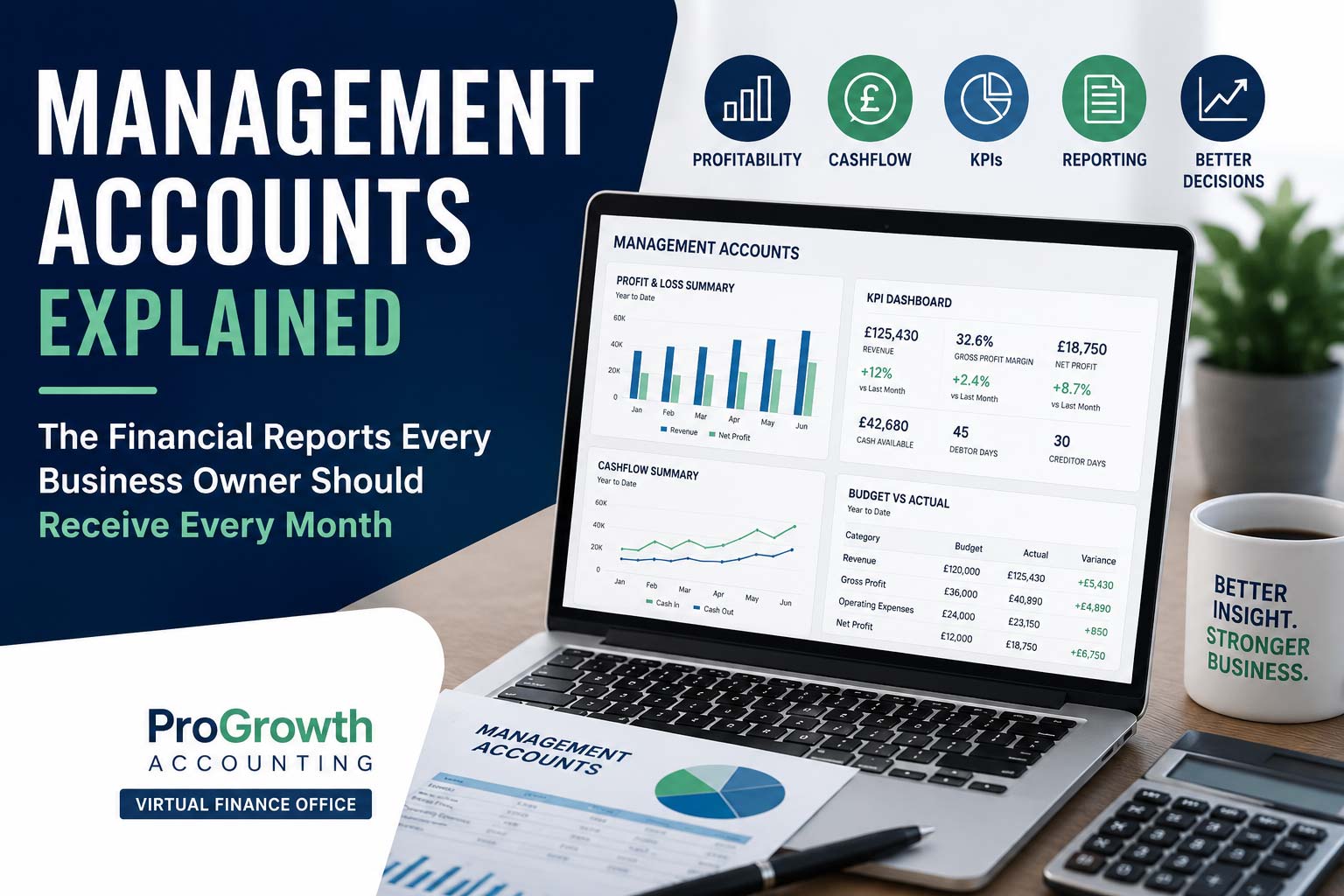
Management Accounts Explained: The Financial Reports Every Business Owner Should Receive Every Month
Your annual accounts tell you where your business was. Management accounts tell you where it’s going.
Imagine driving from London to Edinburgh using a sat nav that only updates once a year.
You’d never reach your destination.
Yet thousands of UK business owners make decisions every day without current financial information. They wait until the end of the financial year to discover whether they made a profit, whether margins have fallen or whether cashflow problems have been building for months.
By then, it’s often too late to take corrective action.
That’s why successful businesses rely on monthly management accounts rather than annual accounts alone.
What Are Management Accounts?
Management accounts are a set of monthly financial reports prepared for business owners and directors to help them understand the current performance of their business.
Unlike statutory accounts, which are prepared primarily for Companies House and HMRC, management accounts are designed to support better decision-making.
They answer questions such as:
- Am I making more profit than last month?
- Which services are most profitable?
- Are my overheads increasing?
- Can I afford to recruit another employee?
- Is my cashflow healthy?
- Will I have enough money to pay my VAT and Corporation Tax?
- Am I on track to achieve my annual targets?
Management accounts transform financial data into practical business intelligence.
What Should Monthly Management Accounts Include?
A professional management accounts pack should include far more than a Profit and Loss report.
1. Profit and Loss Statement
This shows:
- Revenue
- Cost of sales
- Gross profit
- Operating expenses
- Net profit
The key isn’t simply knowing the figures—it’s understanding why they have changed.
For example:
- Why has gross profit fallen?
- Why have marketing costs increased?
- Why is payroll now taking a larger share of turnover?
2. Balance Sheet
Many business owners rarely look at their balance sheet.
That is a mistake.
The balance sheet tells you:
- What your business owns
- What it owes
- The value of your assets
- Available cash
- Outstanding debts
- Business equity
It provides an overall picture of your financial health.
3. Cashflow Report
A profitable business can still fail if it runs out of cash.
Your cashflow report should show:
- Cash received
- Cash spent
- Upcoming liabilities
- Expected VAT payments
- Payroll commitments
- Forecast cash position
Understanding cashflow allows directors to act before problems become critical.
4. KPI Dashboard
Most business owners don’t have time to analyse dozens of reports.
That’s why we recommend a simple dashboard highlighting the most important financial indicators.
Examples include:
- Monthly turnover
- Gross profit margin
- Net profit margin
- Cash available
- Debtor days
- Creditor days
- Working capital
- EBITDA
- Average customer value
- Revenue per employee
These KPIs provide an instant snapshot of business performance.
5. Budget vs Actual Performance
One of the most valuable sections of any management report compares actual results against your budget.
This quickly highlights:
- Areas performing better than expected
- Overspending
- Revenue shortfalls
- Improving profitability
- Emerging risks
Without a benchmark, it’s difficult to know whether performance is genuinely improving.
6. Director Commentary
Numbers alone don’t tell the full story.
Every management accounts pack should include commentary explaining:
- Why results changed
- Key business risks
- Opportunities for improvement
- Recommended actions
- Financial trends to monitor next month
This is where experienced accountants and finance directors add real value.
Management Accounts vs Statutory Accounts
| Statutory Accounts | Management Accounts |
|---|---|
| Prepared annually | Prepared monthly |
| Historic information | Current performance |
| Submitted to HMRC and Companies House | Used internally |
| Compliance focused | Decision making focused |
| Legal requirement | Best practice |
| Limited business insight | Detailed commercial insight |
Both are important.
However, if you only receive annual accounts, you’re managing your business using outdated information.
Why Management Accounts Matter
Better Decision Making
Good decisions require good information.
Whether you’re recruiting, investing, purchasing equipment or expanding into new markets, accurate financial data reduces risk.
Improved Profitability
Many businesses increase turnover while profits decline.
Monthly reporting identifies falling margins before they become major problems.
Stronger Cashflow
Cashflow issues rarely appear overnight.
Management accounts highlight trends early, giving directors time to respond.
Easier Access to Finance
Banks and investors prefer businesses that understand their numbers.
Reliable management reporting demonstrates strong financial control.
Better Tax Planning
Receiving financial information throughout the year creates opportunities to plan ahead rather than reacting after year-end.
How Often Should Management Accounts Be Prepared?
For most growing businesses, management accounts should be prepared every month.
This provides timely information without creating unnecessary administration.
Businesses experiencing rapid growth or significant cashflow pressure may benefit from more frequent reporting.
Ten Financial KPIs Every Business Owner Should Monitor
If you only tracked ten numbers each month, they should be:
- Revenue
- Gross profit margin
- Net profit margin
- EBITDA
- Cash available
- Debtor days
- Creditor days
- Operating expenses as a percentage of revenue
- Revenue per employee
- Cashflow forecast
These indicators provide a balanced view of profitability, liquidity and operational performance.
Common Mistakes Business Owners Make
Waiting Until Year-End
Many directors only review financial performance when their annual accounts are prepared.
By then, opportunities have already been missed.
Focusing Only on Turnover
Revenue is important, but profit and cashflow are what keep businesses sustainable.
Ignoring the Balance Sheet
Your balance sheet reveals hidden risks such as growing debtor balances, excessive borrowing or declining working capital.
Making Decisions Based on Bank Balance
The money in your bank account today doesn’t necessarily belong to your business.
Future VAT, Corporation Tax, PAYE and supplier payments all need to be considered.
Who Should Receive Monthly Management Accounts?
Management accounts are particularly valuable for:
- Limited companies
- Growing SMEs
- Recruitment agencies
- Construction businesses
- Property companies
- Professional services firms
- Healthcare providers
- Education and training providers
- Businesses preparing for investment or sale
If your turnover is increasing or you’re employing staff, monthly reporting quickly becomes an essential management tool.
Frequently Asked Questions
Are management accounts compulsory?
No. Unlike statutory accounts, management accounts are not a legal requirement.
However, they are considered best practice for businesses that want to grow sustainably.
How quickly should management accounts be produced?
Ideally within seven to ten working days after the end of each month, allowing directors to act while information is still current.
Can management accounts improve profitability?
Yes. Regular reporting identifies issues such as falling margins, increasing costs and poor cashflow, enabling management to take corrective action sooner.
What’s the difference between bookkeeping and management accounts?
Bookkeeping records financial transactions.
Management accounts analyse that information, explain performance and provide insights to support business decisions.
How ProGrowth Accounting Can Help
At ProGrowth Accounting, we prepare clear, easy-to-understand management accounts that go beyond the numbers.
Our monthly reporting includes meaningful commentary, KPI dashboards, cashflow forecasting and practical recommendations that help business owners improve profitability and make confident decisions.
As part of our Virtual Finance Office, you’ll receive regular financial insight—not just year-end compliance.
Whether your goal is to increase profits, improve cashflow, secure funding or prepare your business for sale, we’ll help you understand exactly what your numbers are telling you.
Ready to Take Control of Your Business Finances?
If you’re still waiting until year-end to find out how your business is performing, it’s time for a different approach.
Contact ProGrowth Accounting today to discover how monthly management accounts can give you greater clarity, stronger financial control and the confidence to grow your business.